
A realistic view on technological sovereignty and the importance of control points

Author: Amber Geurts
Since the Second World War, the global economy has increasingly been shaped by international free trade, the acquisition and strengthening of leading positions in value chains, and open knowledge economies supported by effective international cooperation. The just-in-time business model, characterised by limited inventories and outsourced production, has led to highly efficient logistical processes.
However, rising geopolitical tensions and growing concerns about strategic autonomy and technological sovereignty point to a shift in this worldview: away from the paradigm of open innovation and free trade, towards a new paradigm in which economic security, market power, and the protection and promotion of strategic sectors and control points take centre stage. A realistic view on technological sovereignty and the importance of control points is therefore essential.
TNO Vector research on control points
The past two years, I have built a strong and growing research team that is conducting research into such control points. After all, it is a relevant and innovative question how companies can become (or remain) a strategic and competitive asset for a country in this changing global arena, divided into sovereign and competing states. Questions such as what control points are, why they are important, and how they can be identified have been central to this work.
Strategic insight into key control points and dependencies is, however, largely lacking, and many examples are anecdotal rather than based on systematic analysis. This means that the strategic intelligence needed to enable targeted policy interventions is missing. Such an evidence base is required to test policy and strategy options, assess proportionality and risks, and design measures that protect the Netherlands’ competitiveness without undermining international cooperation.
By focusing specifically on control points within the National Technology Strategy, TNO Vector has taken a first step towards offering such a strategic, data-driven evidence base with regard to potential current and future control points. Our approach is explicitly integrated: sectors and goods provide insight into existing market and trade structures and potential current control points, while a focus on technologies and (new) firms offers insight into the economic structures of the future, and thus into possible future control points.

‘To become technologically sovereign, we need to strengthen innovation ecosystems and establish international partnerships.’
Amber Geurts, Senior Researcher and Advisor on Innovation and Innovation Policy
A realistic picture
Our work on control points therefore provides the strategic intelligence needed to assess the position of the Netherlands. A realistic picture does not solely look at the domestic situation, but places it within a broader global context - precisely because we come from a period of strong international interdependencies. It is also unrealistic to expect the Netherlands to become technologically sovereign, particularly in light of the innovation paradox and the persistent challenges in translating knowledge and technology positions into new products and services. To achieve technological sovereignty, the Netherlands must strengthen domestic innovation ecosystems and enter into international partnerships with like-minded countries to safeguard access and improve performance.
In this reflection, I emphasise the importance of such a realistic view on technological sovereignty and control points. I underline this necessity by focusing specifically on the role of China.
A realistic picture: the role of China
In our recent report, produced in support of the Wennink report, there is an apparently simple figure. This figure shows developments over the past ten years in the size and impact of countries’ patent portfolios worldwide, focusing on the ten key technologies that are central to the National Technology Strategy. The Netherlands is compared with a set of benchmark countries, selected on the basis of their high R&D investments.
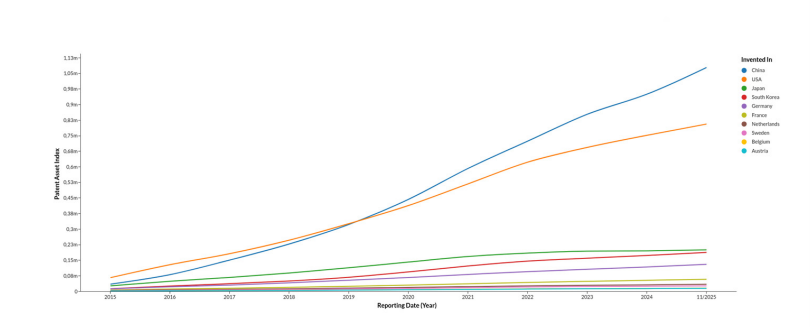
Trends over the past ten years in the size, innovation value and market value (PAI) of NTS patent portfolios worldwide. Source: TNO Vector, Looking under the hood (in Dutch).
The figure reveals the exceptional growth in both the size and impact of patents filed by Chinese companies. Since 2020, China has overtaken the United States, meaning that it now accounts for the largest share of the global innovation and market value of NTS patents. An increasing number of key technological developments are also building on Chinese patents. European countries play a more limited role in comparison with these frontrunners; within Europe, Germany holds the largest share.
A strategic risk with long-term consequences
It is precisely this seemingly simple figure that is of great importance. Patents function as a key indicator of a country’s ability to shape the future. Countries that lead in research and innovation shape the technologies that will determine the geopolitical power of the next generation.
Moreover, scientific leadership cannot easily be restored. It requires decades of sustained investment in researchers, technical talent, infrastructure, new firms, scale-up, manufacturing, and other enabling conditions for research and innovation.
As such, this simple figure points to a strategic risk with long-term consequences: China is increasingly determining the direction of technological progress and is also capturing a significantly larger share of the economic value created.
This risk is compounded by the Netherlands’ strong dependence on Chinese production chains. Recent experience with Nexperia has shown that weaponising interdependence cuts both ways. China’s rise also highlights concerns about the leakage of knowledge from semiconductor companies such as Nexperia and Ampleon - precisely because knowledge is a strategic asset on which the Netherlands builds.
Conclusion
The shift from an open, free-trade-driven world order to a geopolitically and economically coloured competitive one calls for a realistic and strategic reorientation, in which economic security, strategic autonomy, future-proof innovation and control points are central. China’s sustained investment power should serve as a wake-up call: rapid advances across virtually all key technologies are enabling China to play an increasingly decisive role in technological and economic power formation.
For the Netherlands, this means policy can no longer rely solely on a strong knowledge base and open markets. Instead, it must focus on identifying strategic value positions and control points; strengthening and scaling these control points; safeguarding critical knowledge and talent; and reducing chokepoints. By structurally embedding strategic intelligence in decision-making, government can anticipate dependencies, risks and opportunities in a timely manner, and make targeted choices that sustainably support the resilience and competitiveness of the Netherlands in a changing global context.
Questions? Get in touch with us
-

Amber Geurts
Functie:Senior Researcher and Advisor on Innovation and Innovation PolicySpecialisatie niet bekendI am Amber Geurts, researcher and advisor on innovation and innovation policy at TNO Vector. As an innovation scientist, I take a systemic and inter- and transdisciplinary perspective on innovations and their contribution to society. Within TNO Vector, I specialize in transformative innovation policy, which means policy aimed at fundamental societal changes (transitions and transformations) to address complex societal challenges. A specific current focus is on control points for technological sovereignty and open strategic autonomy.-
E-mail:E-mail Amber
-
LinkedIn:Amber on LinkedIn
-
-

Cor Jorna
Functie:Business DeveloperSpecialisatie niet bekend-
E-mail:E-mail Cor
-
LinkedIn:Cor on LinkedIn
-