How cities are working with Positive Energy Districts
Positive Energy Districts (PEDs) are often seen as a promising step towards climate-neutral cities. However, those who start working with them quickly realise that this is not just a technical concept. Developing a PED is a complex urban challenge in which energy, spatial development, regulation, financing and collaboration are closely interconnected.
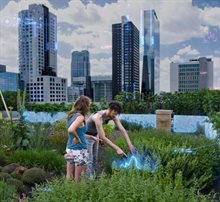
Within the European ATELIER project, this complexity became tangible. In Amsterdam and Bilbao, PEDs have been developed in practice, while eight other European cities worked on plans to apply these insights in their own urban contexts. The project has clearly shown how much alignment and collaboration is required between public and private parties to realise such area-based energy concepts.
What is a Positive energy district?
A Positive Energy District is an urban area that, over the course of a year, generates more renewable energy than it consumes. This is achieved by reducing energy demand, making use of local generation and intelligently organising flexibility within the energy system. Buildings, mobility and energy infrastructure are considered as an integrated system. For cities, this is attractive, but also complex. A PED does not result from a single measure or technology. It requires strategic choices at the intersection of spatial development, energy supply, collaboration, regulation and implementation.
ATELIER: learning by doing in European cities
TNO Vector was involved in the ATELIER project, a European Horizon 2020 initiative in which cities, knowledge institutes, market parties and other stakeholders collaborated on the development of Positive Energy Districts. In Amsterdam and Bilbao, these districts have been realised over the past 6.5 years. In addition, eight other European cities worked on plans to translate the lessons from these two cities to their own contexts.
Within ATELIER, TNO Vector focused on connecting substantive knowledge with the day-to-day practice of urban energy projects. We brought together partners with expertise in energy systems, sustainable buildings, legal issues and financing, and helped make this knowledge applicable within the development of the PED in Amsterdam. At the same time, we supported the exchange of experiences between cities and other European knowledge and practice partners. In doing so, we contributed both to the substantive development of the project and to bundling and applying the lessons learned.
We fulfilled this role in close collaboration with TNO colleagues from Mobility and Built Environment and with knowledge partners such as the Amsterdam University of Applied Sciences and the AMS Institute.
Collaboration embedded in the project design
Within ATELIER, collaboration was structurally embedded in the project design through the Innovation Ateliers. These were collaborative structures in which public and private stakeholders worked together on issues related to governance, financing, legislation and planning. Within these Ateliers, bottlenecks could be discussed, decisions prepared and next steps aligned.
This took place within local projects and between cities, enabling experiences and expertise from different contexts to be shared. The Ateliers thus formed a practical environment in which collaboration was deliberately organised.
What practice shows
The experiences within ATELIER show that collaboration in these types of projects requires continuous attention. Especially in the early phases, roles and responsibilities are often not yet clearly defined, while decisions already need to be taken on technology, ownership, financing and spatial integration. At the same time, legal, financial and technical conditions change during the process.
An important lesson from ATELIER is the need to pay attention early on to organisational design. Delays arise when decision-making, ownership and responsibilities only become clear at a later stage. By bringing together technical, legal, financial and policy issues from the outset, greater clarity and direction can be achieved.
It is also important to create space for learning and adjustment. Conditions change, insights evolve and choices sometimes need to be revised. A strong collaboration structure helps cities and partners to manage this throughout the process.
View all project deliverables here
From project experience to practical guidance
The experiences from ATELIER have been translated into concrete guidance for other cities and project partners. For example, the Innovation Ateliers guide sets out step by step how valuable collaboration can be established, used and further developed. For each phase, the guide indicates which questions, activities and agreements can be helpful.
In addition, a practical and visual PED planning guide has been developed. This guide brings together lessons learned over recent years and shows how cities can take initial steps within their own context.
The ATELIER project website also provides all deliverables, including insights into how cities have monitored their progress, the challenges they encountered and the lessons learned. Monitoring across multiple cities highlights recurring issues and provides concrete starting points for others.
Getting started with these insights
Experiences with Positive Energy Districts highlight the breadth of this challenge in practice. It involves technology, organisation, collaboration and the way in which different parties jointly shape an urban transition. Are you working on urban energy challenges and want to apply these insights in your own context? We are happy to think along with you on organising collaboration, translating project lessons into practical approaches and connecting technical, policy and organisational knowledge.
Questions? Get in touch with us
-

Jeroen Brouwer
Functie:Senior project manager and researcherSpecialisatie niet bekendJeroen Brouwer is my name, working as a senior project manager and research scientist at TNO Vector in The Hague.
-
E-mail:E-mail Jeroen
-
LinkedIn:Jeroen on LinkedIn
-
-

Ines van der Klip
Functie:ConsultantSpecialisatie niet bekendI am Inés van der Klip, a consultant at TNO Vector. My work focuses on societal challenges in which many parties, interests, and systems come together. I analyze where processes get stuck and translate ambitions into concrete, actionable steps. I aim to make an impact by bringing clarity to complex projects and organizing collaboration in such a way that plans actually move toward realization.-
E-mail:E-mail Ines
-
LinkedIn:Ines on LinkedIn
-