Unlocking the power of Digital Trust: why it is key to a resilient and sovereign digital economy
Digital innovation is changing every aspect of our economy and society. From public services and healthcare to finance, mobility, and energy: digital technologies are increasingly embedded in how we work and live. Amid this digital acceleration, there is one factor that determines whether this transformation leads to broad prosperity and resilience or to strategic vulnerability: Digital Trust.

At TNO, we see Digital Trust as a cornerstone for a resilient and sovereign digital Europe. Without Digital Trust, we risk becoming dependent on foreign actors, losing control over critical data, and failing to capture economic opportunities. With Digital Trust, we can build a competitive, fair, and resilient digital ecosystem where organizations innovate confidently and citizens feel secure.
This Insights article explores what Digital Trust really means, why it matters now, and what steps the Netherlands and Europe must take.
What is Digital Trust, and why now?
Digital Trust is the confidence that people, businesses, and governments have in the digital ecosystems they rely on. It’s not a single technology. It’s the combination of:
- Technological trust: Are systems secure? Are digital identities assured? Is data protected?
- Economic trust: Can organizations innovate and collaborate without risk spiralling out of control? Can they rely on partners?
- Socio-ethical trust: Are digital technologies aligned with our values, norms, and democratic principles?
These elements together form the ’trust fabric’ of a digital society. When this fabric is weak, technologies are adopted slowly or not at all. When it is strong, adoption accelerates and value creation follows.

‘Trust in the digital world is deeply intertwined with economic resilience and strategic autonomy. You can’t build sovereign digital infrastructures if people don’t trust the technologies that underlie them. And this matters especially for us as Europeans: our (digital) economic model is built on transparency, fairness, and public value. In 2026, strengthening Digital Trust is no longer a side theme, it is the foundation for safeguarding both our strategic autonomy and our values.’
Tom Barbereau, scientist at TNO Vector
Globally, the importance of trust is rising fast. Research by organisations such as the World Economic Forum and McKinsey consistently shows that Digital Trust delivers substantial economic value. The US and China invest heavily in digital infrastructures, capabilities, and platform ecosystems. Europe’s strength is not scale, but a values‑driven model. Digital Trust is our differentiator and our strategic advantage.
From fragmentation and security to sovereignty: Trust as a strategic asset
Across Europe, many initiatives aim to strengthen Digital Trust: from the governance of artificial intelligence to frameworks for digital resilience, digital identity standards, and sector‑specific regulations. However, these efforts often remain siloed.
For decades, Digital Trust was viewed mainly through the lens of cybersecurity or privacy. Today, the discussion is much broader. To unlock the full potential of Digital Trust, Europe needs an integrated approach. This approach builds on three perspectives:
1.
Sovereignty, autonomy, and control
To remain digitally sovereign, nations must control essential assets across the digital stack and at the intersection of its layers. These layers include cloud infrastructures, identity and access management systems, data exchange frameworks, and more. Without control over these layers, Europe becomes dependent on foreign players and that dependency shapes political and economic decisions – leading to a loss of trust.
2.
Economic competitiveness
Organisations with high levels of Digital Trust adopt new technologies faster, share data more efficiently, reduce compliance risks and build stronger customer relationships. Trust directly translates into innovation capacity and competitive advantage. Overall, trust contributes to economic growth.
3.
Societal resilience
People want digital services they can rely on. They want transparency, fairness, and accountability. Without societal trust, even the best technologies face public resistance. Digital Trust is therefore not a ’nice to have’. It’s the foundation for a resilient, democratic, and innovative society.
A TNO reference frame: connecting all perspectives
To bring clarity to this complex field and provide an integrated approach, TNO developed a Digital Trust reference frame. It maps the key aspects of Digital Trust, the stakeholders involved, and their roles, interests and illustrative interactions.
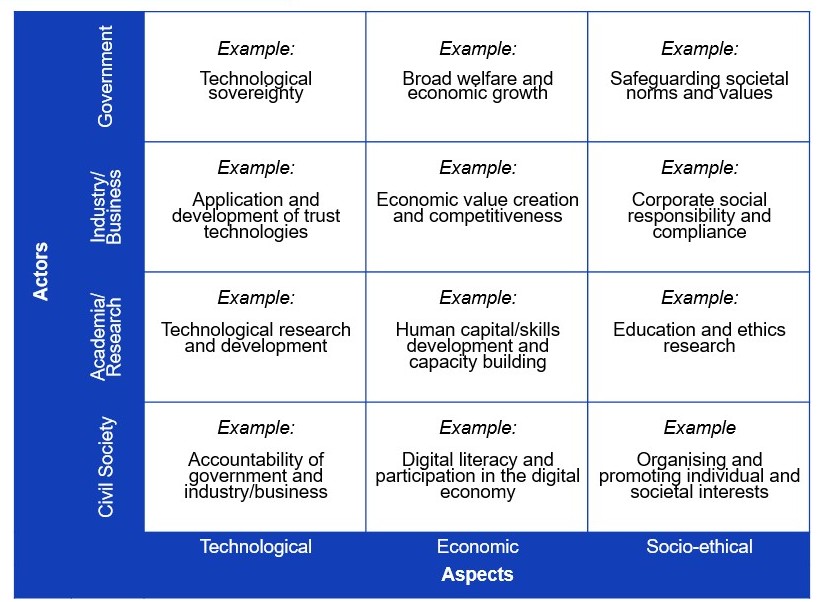
This matrix helps policymakers, business, researchers, and societal actors better understand each other’s priorities and collaborate more effectively. It is already being used in ecosystem discussions, policy workshops, and innovation programs.

‘Digital Trust touches technology, economics, governance, and society - and these worlds rarely speak the same language. The reference frame helps to create a shared understanding. It gives stakeholders a common structure to identify overlaps, gaps, and joint priorities. For Europe, where collaboration and value-driven innovation are essential, that clarity is crucial.’
Augustinus Mohn, research manager at TNO Vector
Trust technologies and their governance
Technologies such as privacy‑enhancing technologies, digital identities and zero‑knowledge proofs play a crucial enabling role for Digital Trust. When combined with robust governance, they enable secure and scalable collaboration in sensitive domains such as healthcare, finance and government. Therefore we developed a visual representation of these trust technologies (or ‘trust tech’ for short) – including requirements that derive their use and possible advantages.
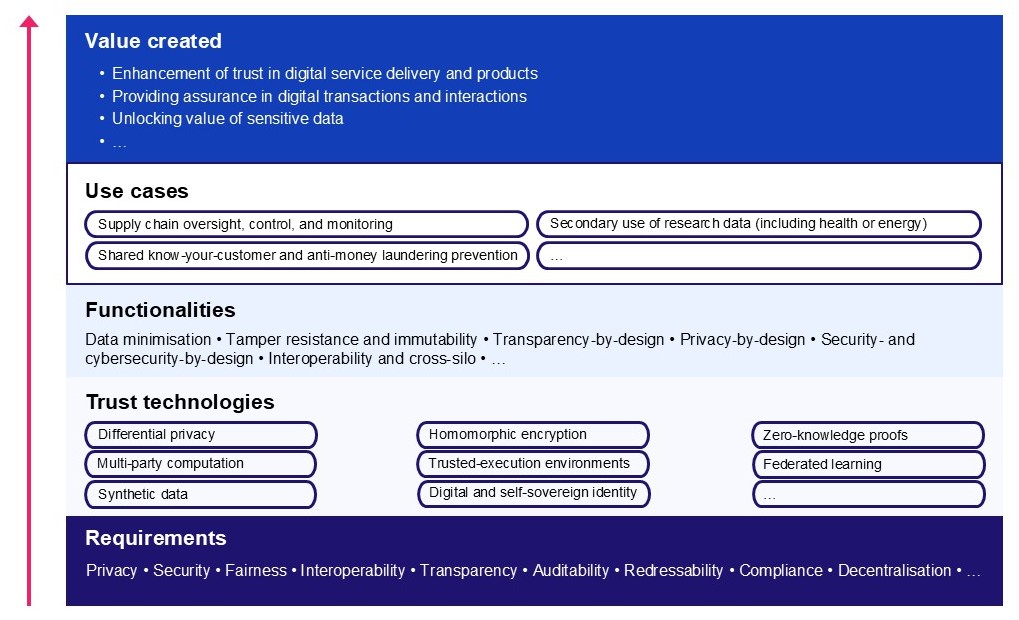
Where trust tech is combined with good governance, value creation follows.
Three action lines for impact
To unlock the full socio economic potential of Digital Trust, we define three interconnected action lines working together, rather than in isolation:
- Integrate trust at the core of digital transformation by embedding trust enabling technologies, developing clear norms and labels, and translating abstract frameworks into practical tools.
- Innovate by investing strategically in areas where Europe currently underperforms (’whitespots’) and by combining technology agnostic research with technology or industry specific programs.
- Ideate and educate by fostering places and programs that bring people together, in co creation hubs or interdisciplinary training and talent development programs, ensuring Digital Trust becomes a capability embedded in our wider innovation system.
These three action lines reinforce each other: integration ensures impact today, innovation prepares us for tomorrow, and ideation builds the talent and ecosystem to sustain longterm leadership. All underlying concepts, examples, and recommended actions are explained in full detail in the report ‘Innovation and earning power in a digital world: Unlocking the socio-economic potential of Digital Trust’.
Download the report
Questions? Get in touch with us
-

Tom Barbereau
Functie:Scientist Specialist Digital SocietySpecialisatie niet bekendMy name is Tom Barbereau and I am a Scientist Specialist at the research group on Digital Governance and Regulation. I bring passion for disruptive technologies' impact on organisations, modes of governance, and society at large.
-
E-mail:E-mail Tom
-
LinkedIn:Tom on LinkedIn
-
-

Augustinus Mohn
Functie:Head of Department | Digital Governance & RegulationSpecialisatie niet bekendThe Digital Governance & Regulation (DGR) team supports society (Dutch, European and international) in taking on current and future trends concerning digital technologies. We use our expertise to advise clients and stakeholders in the public and private sector on how to build and maintain a safe and secure society, realise the opportunities of digital innovation, and contribute to economic growth and broad prosperity.
-
E-mail:E-mail Augustinus
-
LinkedIn:Augustinus on LinkedIn
-