Why governments must now invest in innovation capacity and innovation power
New municipal councils and local councils are starting at a time of exceptional pressure. The municipal funding cliff (‘ravijnjaar’) of 2026, structural budget deficits, the housing crisis, the need for sustainability, growing inequality and increasingly complex cooperation between layers of government are all converging. At the same time, citizens expect more tailored services, effectiveness and collaboration.

This combination of high expectations and structural pressure makes one thing clear: policy ambition alone is not enough. Governments need innovation capacity and innovation power.
Why innovation is not a luxury but a precondition
The societal challenges are becoming more complex. Housing, energy, healthcare, safety and digitalisation are increasingly interconnected. Municipalities operate within networks of interdependencies involving other governments and societal partners. Traditional approaches focused on stability and risk control fall short when challenges cut across domains and existing structures provide insufficient support.
Change is happening faster than organisations can keep up. Digitalisation, AI, the energy transition, changing legislation, labour shortages and new governance frameworks require organisations to continuously adapt – not sporadically, but structurally.
The demand for execution is growing faster than capacity. With limited resources and personnel, scope for experimentation is often small, while exactly that experimentation is essential to effectively address major challenges.
From national to local: innovation as a common thread
In the national coalition agreement of the Jetten-government, innovation plays a central role: as a driver of economic growth and prosperity, as an instrument for strategic autonomy and security, as a catalyst for major transitions and as a means to move from pilots to structural scaling. These national ambitions fall on the shoulders of local authorities, which are grappling with financial pressure, housing challenges, energy poverty, ageing populations and an already overburdened administrative system.
Innovation is therefore not an end in itself, but a precondition for dealing with other challenges. Moreover, local authorities are where innovation takes shape: in implementation, in area-based approaches, in ecosystems and in new forms of service delivery.
What governments need now
We distinguish two domains that are essential for making public organisations agile: innovation capacity (the internal foundation) and mission-driven innovation power (the joint approach across domains).
Innovation capacity: getting the internal foundation in place
Innovation capacity concerns an organisation’s ability to structurally renew, experiment and adopt new ways of working. TNO defines five elements:
- Leadership: prioritises innovation and creates space
- Organisation: encourages experimentation, collaboration and learning
- Network: strong internal and external connections
- Knowledge management: structural sharing and embedding of knowledge and data
- Learning: continuous reflection to improve faster
These elements form the basis for moving from isolated pilots to structural renewal. Many governments lack this foundation, causing innovations to stall before reaching practice. Investing in these conditions embeds adaptive capacity within the organisation.
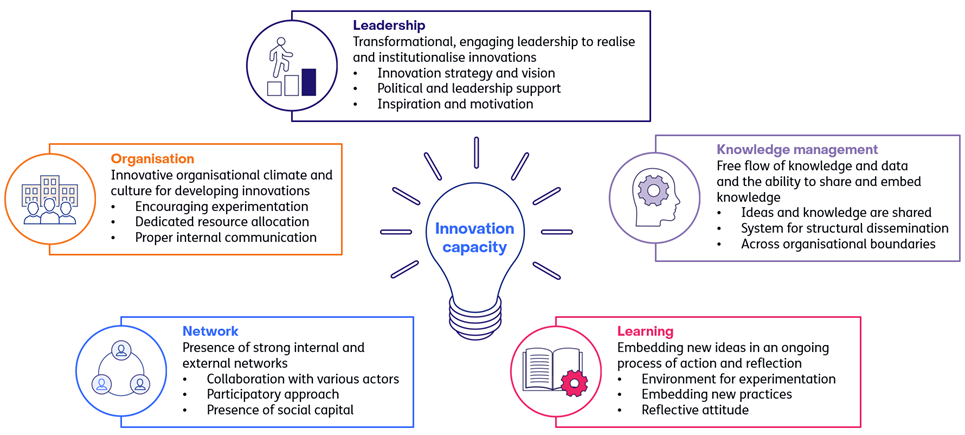
The TNO Innovation Capacity Framework with the five elements.
Mission-driven innovation power: collaboration across boundaries
Mission-driven innovation power concerns the ability of public and private organisations to jointly develop innovations that contribute to societal missions, learn from them and scale them. In practice, this often takes place through public–private partnerships, but these frequently get stuck in fragmented pilots due to silos, unclear vision and mandate, limited learning and diffused ownership.
The Mission-driven Innovation Power model builds on existing insights into innovation capacity and provides a coherent framework to understand these bottlenecks. It places innovation processes at the centre and distinguishes five preconditions: open innovation networks, vision and focus, organisational learning, leadership and organisational culture.
What does this mean for new municipal boards?
New municipal boards are starting at a time when financial pressure, complex transitions and heavy implementation demands reinforce one another. Organisations must not only be able to deliver, but also to learn, adapt and renew. Six factors are crucial for a future-proof term of office.
1.
Strengthen leadership that provides direction and creates space
Clear leadership combined with purposeful experimentation helps explore new solutions and sets the organisation in motion.
2.
Build an organisation that enables renewal
Treat innovation as a structural capability and invest in the five elements of innovation capacity.
3.
Work in an outcome-oriented way and break down silos
Cross-domain teams and shared goals across organisational boundaries make it possible to adapt and respond more quickly.
4.
Strengthen mission-driven collaboration with partners
Major transitions require collaboration with societal partners, entrepreneurs and citizens, supported by the Mission-driven Innovation Power (MIK) model.
5.
Make learning and scaling part of everyday work
Structural reflection, knowledge sharing and evaluation make it easier to scale up and adjust course in a timely manner.
6.
Design adaptive governance that moves with change
Use iterative decision-making, multidisciplinary teams and data-informed steering to act flexibly within clear frameworks.
Breaking down silos within the City of Gothenburg
In MOVE21, we worked with the Living Lab cities of Oslo, Hamburg and Gothenburg to better understand and strengthen innovation capacity. In Gothenburg, innovation capacity was used to improve collaboration between departments and to embed innovation as a structural part of daily work.
To support this, we facilitated, among other things, workshops in which employees of the City of Gothenburg worked with the Innovation Capacity Canvas. They mapped the barriers they encountered and translated these into solutions and strategies. This resulted in a shared language within the organisation and improved collaboration between teams that would otherwise operate in isolation.
‘Even with my many years of experience in urban mobility innovation, working on innovation capacity in this way proved surprisingly valuable. The real benefit was not only in the tools or frameworks, but above all in the exchange of ideas and shared experiences with colleagues from the city who took part. Discussing common frustrations, understanding resistance and learning from each other’s successes and failures created a sense of connection and psychological safety that has continued to shape our day-to-day work.’
Suzanne Green, Project Manager EU Projects, Gothenburg
This is the moment to put innovation at the centre
The coming years will determine how governments deal with the major challenges of our time. The difference between falling behind and maintaining control lies in the ability to learn, renew and remain agile. Investing in innovation capacity and mission-driven innovation power is therefore not a choice, but a prerequisite for future-proof governance.
TNO Vector supports public organisations with proven methodologies, analytical tools and interventions – ranging from the Innovation Capacity Framework to the Mission-driven Innovation Power model and concrete tools and workshops. This ensures that innovation becomes a natural way of working rather than an exception.
Ready to get started with innovation capacity and innovation power?
Do you want to build a government that can handle complexity, learns faster and collaborates more effectively? Get in touch with our experts.
Also interesting
Want to know more? Contact us
-

Marjolein Heezen
Functie:Consultant and researcher urban innovation and mobilitySpecialisatie niet bekendI am Marjolein Heezen, consultant and researcher in urban innovation and mobility at TNO Vector. With my work I commit to bettering the world of today, tomorrow and the day after tomorrow, where - with a lot of courage and chasing of dreams - ambitions become reality.
-
E-mail:E-mail Marjolein
-
LinkedIn:Marjolein on LinkedIn
-
-

Tess Tjokrodikromo
Functie:Researcher Environmental PlanningSpecialisatie niet bekendI am Tess Tjokrodikromo, researcher Environmental Planning at TNO Vector. With a background in public administration and urban planning I work on governance innovation and spatial challenges on a daily basis.
-
E-mail:E-mail Tess
-
LinkedIn:Tess on LinkedIn
-
-

Shanita Rambharos
Functie:Innovation policy advisorSpecialisatie niet bekendI am Shanita Rambharos and I work as an innovation policy consultant at TNO Vector. My work revolves around developing and applying mission-driven and transformative innovation policies that contribute to societal transitions, such as sustainability and digitalisation.
-
E-mail:E-mail Shanita
-