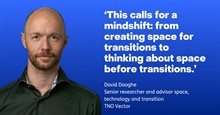
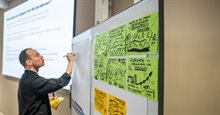
Spatial strategies for transitions
Covers the spatial dimension of societal challenges, including energy infrastructure, housing, climate adaptation, vital systems and regional development, and how scarce space can be used strategically.

Digital sovereignty as key to future earning capacity
Digital sovereignty sometimes sounds like a call to do everything yourself, but during the breakout session at the Vector Symposium it became clear that this misses the point.

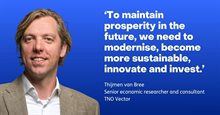
Faster innovation adoption as key to improving labour productivity
Labour productivity is one of the key conditions for earning capacity. The Netherlands is lagging behind in both R&D investment and labour productivity growth.

The innovation engine is faltering; time to increase capacity
Investing in R&D and innovation is essential for a resilient economy and society. Yet the Netherlands is not succeeding in meeting its ambitions for R&D expenditure.

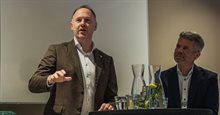
Annual symposium
During the annual symposium on 16 June 2026, we worked on knowledge, guidelines and practical perspectives for the Netherlands as an innovative, entrepreneurial and governing country.

TNO appoints Lotte de Groen as Market Director of TNO Vector

How economic future choices shape the physical living environment of the Netherlands
Economic choices determine the impact on land use, water consumption, and environmental quality in the Netherlands, according to research by TNO Vector and the Ministry of Infrastructure and Water Management.

Much greater openness and collaboration within government on GenAI
Generative AI (GenAI) is gaining momentum across government. From ministries to local authorities, communication about the use of GenAI has increased tenfold in just one year.

How can government scale up AI responsibly?
How do you ensure that AI solutions do not remain stuck in pilots, but scale in a sustainable and responsible way? And how can organisations make use of each other’s successful AI solutions? Read the article.

Mythos highlights the need for European cooperation on AI
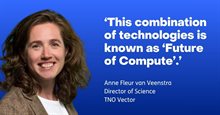
How do we keep our systems secure amid rapid AI developments? Read Anne Fleur’s reflections.

When good intentions are not enough
Which choices are needed to keep the energy transition both feasible and understandable for residents? Read the reflection.

How cities are working with Positive Energy Districts
What can we learn from a European Horizon 2020 project on Positive Energy Districts? The project offers insights into collaboration, governance and implementation within the urban energy transition.

Accelerating energy‑infrastructure development requires clearer choices
The MIEK has strengthened the energy infrastructure, but still calls for sharper choices to accelerate the energy transition. This is shown in the TNO reflection on the MIEK.

When AI floods government services: preparing for an AI-Driven surge in demand
Language models and other forms of AI make it easier to write objections, submit requests, and navigate complex application processes.

A realistic view on technological sovereignty and the importance of control points
The world is shifting from open innovation and free trade towards a focus on economic security, strategic autonomy, and protecting critical sectors and technologies.

Unlocking the power of Digital Trust: why it is key to a resilient and sovereign digital economy
At TNO, we see Digital Trust as a cornerstone for a resilient and sovereign digital Europe.
- 1
- 2
- ...
- 9
- next pagina