
Swift budgetary clarity needed for the innovation instrument portfolio
On 10 July, the Dutch government sent its response to the Wennink report to the House of Representatives, together with a letter on the progress of the Taskforce on Future Prosperity and the Business Climate and the second Productivity Agenda. These documents show that the government recognises the urgency of structurally increasing investment in R&D, the adoption of innovations and the enabling conditions needed to make our economy future-proof. However, if these ambitions are to be realised, major budgetary choices still need to be made this summer and autumn. The pressure appears to be most acute around long-term funding for public-private collaboration in innovation ecosystems.
Taskforce as a response to Wennink
The Taskforce on Future Prosperity and the Business Climate was established to address the most urgent themes identified by Wennink in his report: in particular, declining productivity growth, pressure on public finances and growing technological dependencies in critical societal domains. Like Wennink, the government also recognises the central importance of the economic enabling conditions, such as nitrogen, grid congestion and talent, in reversing these negative trends. Through the Taskforce, the government aims to make choices and build the enabling conditions needed to achieve structural economic growth of 1.5%, which, as Wennink emphasises in his report, is necessary to safeguard our prosperity.
‘To maintain prosperity in the future, we need to modernise, become more sustainable, innovate and invest.’
Strategic industrial policy at the core
The Taskforce on Future Prosperity and the Business Climate has been given four assignments. The government sees the implementation of targeted interventions through strategic industrial policy as the Taskforce’s core assignment. The other three assignments are: stimulating investment, increasing the availability of talent, and strengthening entrepreneurship and the business climate.
Strong collaboration in regional innovation ecosystems
Drawing on the policy agenda Industry policy with focus, the government is focusing on six markets, the targeted development of ecosystems and the stimulation of new economic activity. In doing so, the government and the Taskforce aim to stimulate investment, remove barriers, and implement and scale up promising activities in both existing and new ecosystems. This explicitly involves collaboration with companies, knowledge institutions, public organisations, regional and local authorities, and financiers. The parliamentary letter states that such an integrated approach, in the form of an ecosystem-based approach with industry and other knowledge partners, is indispensable for success. Yet it is precisely around the stimulation of additional R&D expenditure through public-private partnerships in innovation ecosystems that the pressure appears to be mounting.
Changes to the innovation instrument portfolio affect public-private collaboration in innovation
The Schoof government has decided not to fund any new projects after the third round of the National Growth Fund (NGF). Only projects that have already been approved can be completed, which means that spending through the NGF will decline rapidly after 2030 (see Figure 1). With the discontinuation of new NGF rounds, the Netherlands no longer has an instrument that provides long-term support for large-scale public-private innovation collaboration and the strengthening of innovation ecosystems. The PPS-I scheme will continue to exist as the successor to the PPS allowance scheme, but in terms of both budgetary scale and the type of projects it supports, it is of a fundamentally different order from the National Growth Fund, which comprised €20 billion when it was established, while a maximum annual budget of €180 million will be available for the PPS-I scheme.
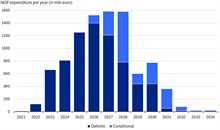
Figure 1: NGF expenditure will be phased out rapidly after 2030
Source: NGF Budget 2025. Estimated annual cash expenditure per NGF project. Adapted by TNO Vector.
The National Growth Fund gap
The discontinuation of the National Growth Fund creates a clear gap in the Dutch innovation support instrument portfolio. The outlines of the future innovation instrument portfolio, as sketched in the coalition agreement and the progress letter on the Taskforce on Future Prosperity and the Business Climate, do not yet make sufficiently clear how this gap will be filled. This is despite the fact that the letter still assigns an important role to the NGF on page 4:
‘In the area of stimulating investment and innovation, the Taskforce is focusing in particular on three initiatives: the National Investment Institution (NII), the National Agency for Disruptive Innovation (NADI) and the National Growth Fund (NGF). Together, these three instruments form a coherent approach: the NGF builds the ecosystems in which innovation emerges, NADI converts innovative strength into societal breakthroughs, and the NII ensures that promising companies find the financing they need to grow.’
Greater clarity is urgently needed on the future innovation instrument portfolio
Both Wennink and AWTI argue that the ‘NGF gap’ should be filled with a new instrument that finances large-scale, long-term research and innovation and strengthens innovation ecosystems. To break through the innovation paradox, a consistent, long-term and targeted innovation instrument portfolio is needed, in which generic instruments such as the WBSO and Innovation Box are complemented by specific, targeted public-private innovation programmes.
Government and parliament must act this summer and autumn
The so-called ‘August decision-making’ process in the run-up to Budget Day is an important first step towards providing greater short-term clarity. But Figure 1 makes clear that it is also essential to set out a clear long-term course for the period after 2030, beyond the current government’s term of office. After all, the assignment letter for the Taskforce on Future Prosperity and the Business Climate already stated: ‘People, companies and knowledge institutions expect progress and clarity; without these choices, our economy risks falling behind.’