Key player or bystander?
Quantum computing is a key technology that is developing quickly and could have major implications for the Netherlands - both for our economy and for national security. While it is difficult to predict exactly when large-scale quantum computers will become a reality, their impact could to be disruptive. Once quantum computers become powerful enough to break certain forms of today’s digital security, this would not merely represent a technological breakthrough, but could also mark the emergence of a strategic geopolitical asset. One that may determine who has access to information, who can preserve an economic advantage, and who is able to exercise international influence.

In the report ‘Key player or bystander?’, TNO Vector, in collaboration with the Ministry of Defence, outlines four future scenarios for 2035 that explore what a world with large‑scale quantum computers could look like. The analysis focuses in particular on how access to this asset - or the lack of it - may shift the international balance of power, security, and dependencies. It also examines which strategic choices we need to make today in order to be prepared for the future.
This article offers an initial insight into the four future scenarios that have been developed. The full report contains more extensive descriptions, insights, and analyses.
Download the full report 'Key player or bystander?' here
Future scenarios for the Netherlands with and without access to a quantum computer and the impact on our digital security.
Quantum computing and our digital security
Quantum computers exploit the unique properties of quantum mechanics, which could enable them to solve certain mathematical problems much faster than classical computers. A key example is Shor’s algorithm: when executed on a sufficiently powerful quantum computer, it can undermine the mathematical foundations of widely used encryption methods. This forms a threat to the security of most our digital communication.
Although current quantum computers are not yet sufficiently powerful, the risk already exists due to the “store now, decrypt later” (SNDL) threat. Data intercepted today may be stored, and decrypted in the future once a quantum computer reaches the required level of capability. For this reason, the transition to quantum‑safe encryption - cryptography that is resilient to attacks by quantum computers - is already urgent.
Scenario analysis as a tool for strategic preparedness
To better understand what a future shaped by quantum computers might look like, scenario analysis is used: a method for exploring multiple plausible future outlooks under conditions of high uncertainty. This approach helps to identify emerging trends, risks and opportunities, and supports the development of strategies that are robust across different possible outcomes.
For this scenario analysis, two core questions were plotted against each other:
- Does the Netherlands have access to a quantum computer capable of executing Shor’s algorithm?
- Do other countries have access to such a quantum computer?
Together, these questions result in four possible future scenarios, with 2035 as the time horizon. Since the implications of these scenarios extend beyond purely technological considerations, each scenario analyses how geopolitics, regulations, ethics, and societal factors shape these potential futures. To further clarify the underlying dynamics, each scenario is illustrated with a fitting analogy that makes the characteristics of each possible future more tangible.
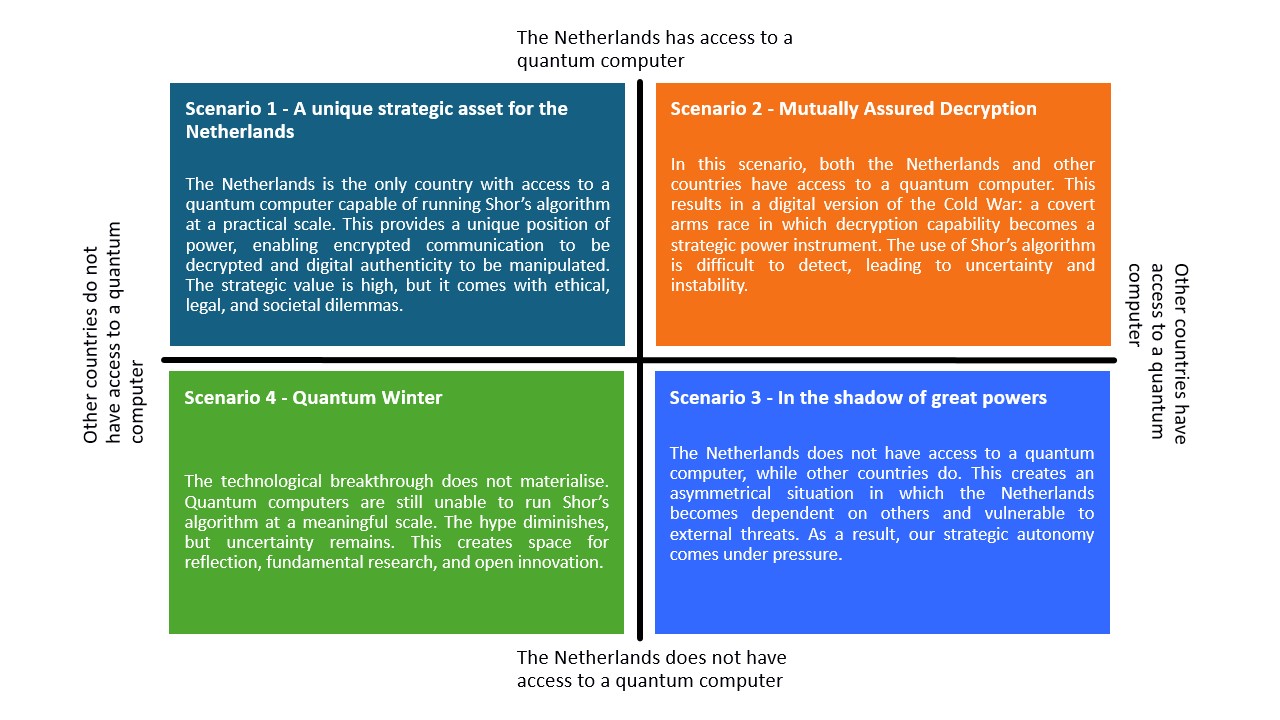
Overview of the two axes and four future scenarios
Four future scenarios
Below, we provide a concise description of the four scenarios, without assessing their likelihood or desirability. The narratives should be understood as stylised extremes that illustrate specific situations, based on the two selected axes.
Scenario 1
A unique strategic asset for the Netherlands. Through a combination of technological breakthroughs, the Netherlands has succeeded in becoming the first - and for the time being the only - country with access to a quantum computer capable of breaking widely used encryption. This exceptional position creates both strategic advantages and significant responsibilities. Who is granted access? How should use and governance be organised in a context where access to knowledge, infrastructure and talent is highly sensitive and may become a target for others? In this scenario, a revision of legal frameworks and clear arrangements regarding transparency, deployment and international cooperation is essential.
The situation recalls the historical example of the Enigma machine during the Second World War, in which decryption capabilities delivered a strategic advantage but also gave rise to profound ethical dilemmas.
Scenario 2
Mutually Assured Decryption. In this scenario, both the Netherlands and other countries have access to a quantum computer capable of executing Shor’s algorithm at a practical scale. Because the use of this technology can take place without leaving visible traces, a high degree of uncertainty emerges. Digital security becomes a state of mutual vulnerability, in which countries do not know whether their digital communications have already been intercepted and decrypted. Even if the transition to quantum‑safe encryption has been fully completed, there remains a risk that information may still be exposed through the SNDL strategy.
This situation mirrors the logic of the Cold War: mutual vulnerability forms the basis of an inherently fragile balance.
Scenario 4
Quantum Winter. In this scenario, the anticipated technological breakthrough has not materialised. Quantum computers remain too limited in their computational power to execute Shor’s algorithm at a relevant scale. This offers temporary relief: the immediate threat recedes and countries shift their attention to other priorities. However, the underlying uncertainty persists. The SNDL threat does not disappear, and an unnoticed breakthrough elsewhere could still abruptly alter the balance of power.
For the Netherlands, this scenario creates a window of opportunity to carefully plan and execute the migration to quantum‑safe encryption and to further develop standards. At the same time, it demands continued vigilance: talent may drain away, investments may decline and a technological gap may develop quietly over time.
The situation is comparable to the development of nuclear fusion; a technology with great promise, but with a breakthrough that continually seems just out of reach. While urgency temporarily recedes, preparedness remains essential.
Scenario 3
In the shadow of great powers. If other countries do possess a cryptographically relevant quantum computer and the Netherlands does not, our strategic autonomy comes under pressure. How can the Netherlands build or maintain strategic positions without direct access to this technology? As great powers expand their lead, the Netherlands must accelerate its transition to quantum‑safe encryption, invest in control points within value chains, and seek coalitions that help safeguard its strategic autonomy.
The analogy with the Netherlands’ historical dependence on the United States’ GPS system seems fitting here: those without core capabilities must build upon and rely on others and accept the geopolitical and technological consequences.
Key commonalities across the scenarios
Despite significant differences between the four futures, several clear common elements emerge:
- Migration to quantum‑safe encryption is essential in all scenarios. Regardless of when cryptographically relevant quantum computers become a reality, this remains a fundamental condition for secure digital communication.
- Technological dependencies and the importance of control points within value chains play a role in every scenario. Direct access to quantum computers, as well as indirect influence through components, knowledge positions and standards, are strategically significant.
- Robust governance and clear legal frameworks are crucial. Because decryption can take place invisibly, transparency, legitimacy and societal values are particularly important.
- International cooperation is a key factor, especially in scenarios involving asymmetric access to quantum computers. Coalition‑building and diplomatic networks are essential for maintaining access to knowledge and infrastructure and for establishing shared norms.
Conclusion
The four scenarios demonstrate that the emergence of a cryptographically relevant quantum computer can unfold in different ways, and they clarify which actions can already be taken today to remain agile and resilient across a range of possible futures.
A consistent insight across all scenarios is that waiting is not an option. Investment in quantum‑safe encryption is relevant in every scenario, as it protects information that might otherwise be decrypted in the future. Moreover, the Netherlands can remain a relevant global actor by securing strategic positions in value chains, even without possessing its own quantum computer. Finally, clear governance principles on access, deployment and responsible use are required to safeguard legitimacy, transparency and public trust.
Although the precise timeline remains uncertain, the scenarios show that the Netherlands must already prepare for a future in which quantum computers may fundamentally affect digital security.
Are you curious to explore how the four scenarios unfold in more detail, which risks and opportunities they reveal, and how the Netherlands can already prepare for such a future? The full report (in Dutch) offers an accessible and in-depth perspective on possible future worlds, and on what can be done today to be prepared.
Want to know more? Contact us
-

Julian Rabbie
Functie:Consultant Quantum TechnologySpecialisatie niet bekendI am Julian Rabbie, Sr. Orchestrator Quantum Technology at TNO Vector. My mission is to create a strategically autonomous quantum ecosystem in the Netherlands and the European Union.
-
E-mail:E-mail Julian
-
LinkedIn:Julian on LinkedIn
-
-

Iris Kaliën
Functie:Consultant Quantum TechnologiesSpecialisatie niet bekend-
Telefoon:+31 6 25 70 39 07
-
E-mail:E-mail Iris
-
-

Cor Jorna
Functie:Business DeveloperSpecialisatie niet bekend-
E-mail:E-mail Cor
-
LinkedIn:Cor on LinkedIn
-