Beyond ‘wicked problems’: a new way to understand complex societal challenges
Climate change, the energy transition and polarisation are often described as complex - or even wicked - problems. These labels signal that an issue is difficult, but they do not help explain exactly why, or which interventions are appropriate. Our research shows how complex societal challenges can be analysed more precisely by building a profile of different forms of complexity.
Many typologies already classify societal problems using a few characteristics. Yet these typologies often remain abstract and offer limited guidance for analysing concrete challenges. They can also lead to misclassification, with real risks: reductionistic or overly complex solutions, politicisation or even decision-making paralysis. This is partly because stakeholders may interpret the same issue in different ways. As systems thinker Russ Ackoff put it: “What one person considers a problem, another may consider an opportunity.” That is precisely why a more detailed analysis of problem complexity is needed.
Therefore, we reviewed 25 influential typologies from policy studies, systems sciences and management sciences. We extracted the underlying characteristics of complexity and grouped them into a layered framework.
Research article
Discover how complex societal challenges can be better understood using a framework that profiles different forms of complexity.
Not all complex problems are the same
The literature repeatedly makes the same core distinction: complexity lies both in the system itself (system complexity) and in the differences between the parties involved (stakeholder divergence). Strikingly, many existing approaches focus mainly on differences between stakeholders, while the characteristics of the underlying system often receive less emphasis.
System complexity captures the structure, dynamics, and scope of a problem. Think of an energy system in which households, businesses and solar farms both consume and provide electricity at different moments, or of the many parties involved in the healthcare chain.
Stakeholder divergence refers to differences in values, interests, knowledge and power. This can be illustrated by the start of the COVID-19 pandemic, when trade-offs had to be made under limited knowledge between interests such as public health and the economy, leading to relatively centralised measures such as the evening curfew.
Because the framework consists of several levels, it supports problem analysis at different degrees of detail. Where most existing typologies set two factors against each other (level L1), this framework can also include more factors (levels L2 and L3). The result is a sort of fingerprint.
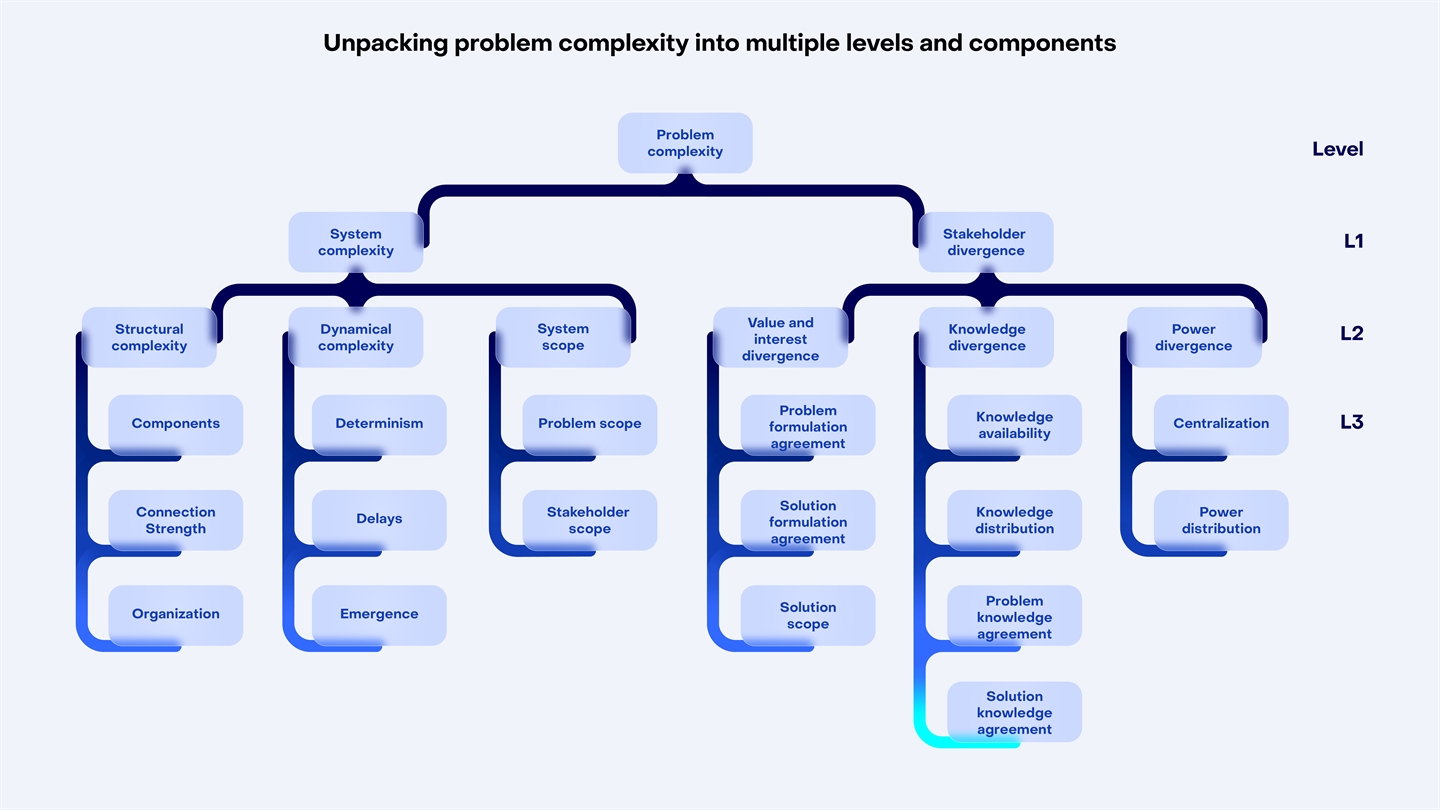
Unpacking problem complexity into multiple levels and components.
A fingerprint, not a label
Rather than simply labelling an issue as 'wicked' or 'complex', the framework makes it possible to build a complexity profile, a fingerprint. Visualising this profile in a radar diagram, for example, makes visible which factors dominate in a specific case. Two situations may have the same degree of system complexity, while one has a much stronger knowledge base than the other.
In an energy-related challenge, the greatest difficulty may lie in technical dependencies, grid congestion and delay effects. In that case, modelling or scenario analysis is an obvious route. In a spatial planning process, the central challenge may instead be conflicting values, interests and responsibilities. Dialogue, participation and joint problem structuring then become more important.
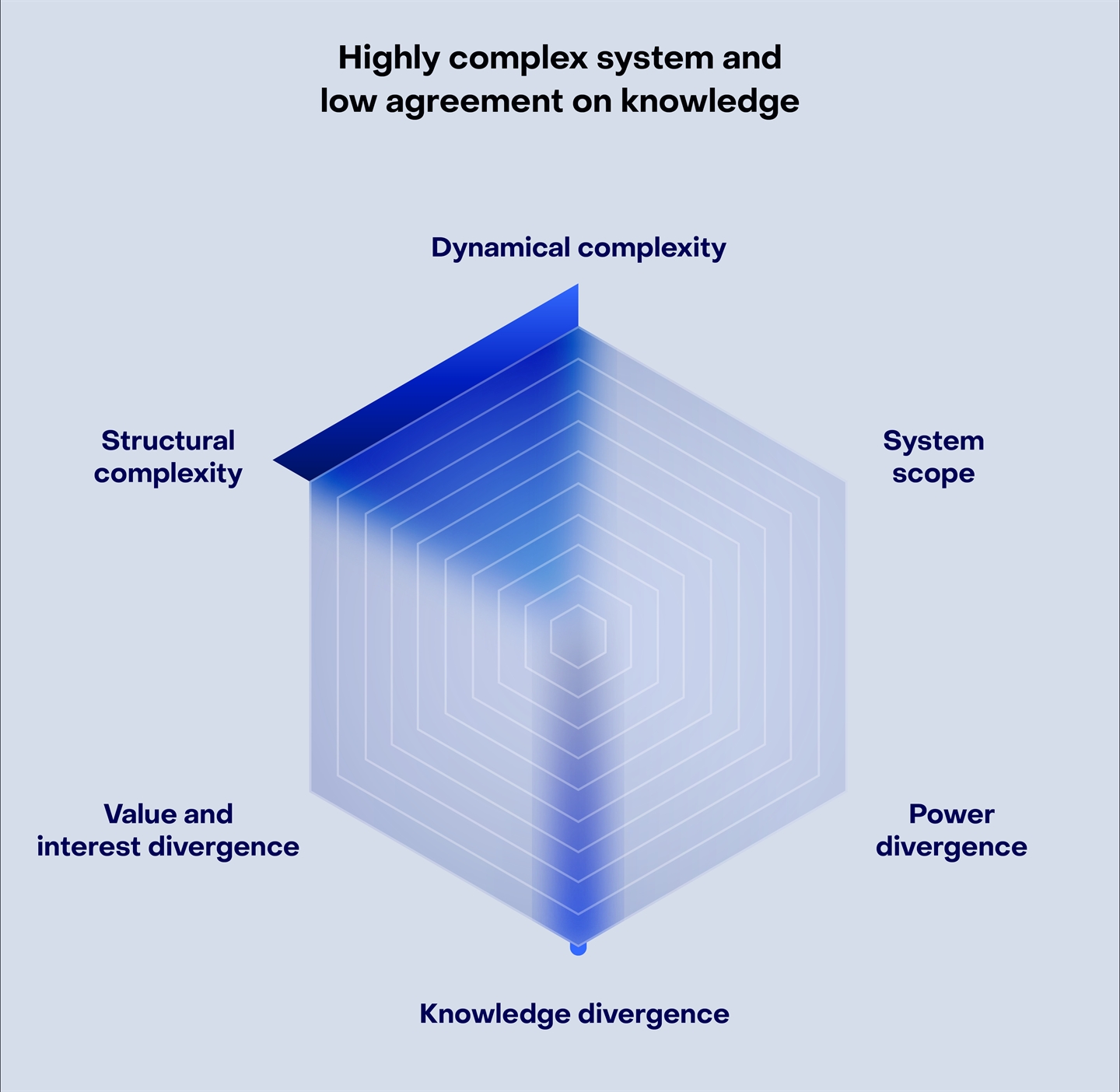
Highly complex system and low agreement on knowledge.
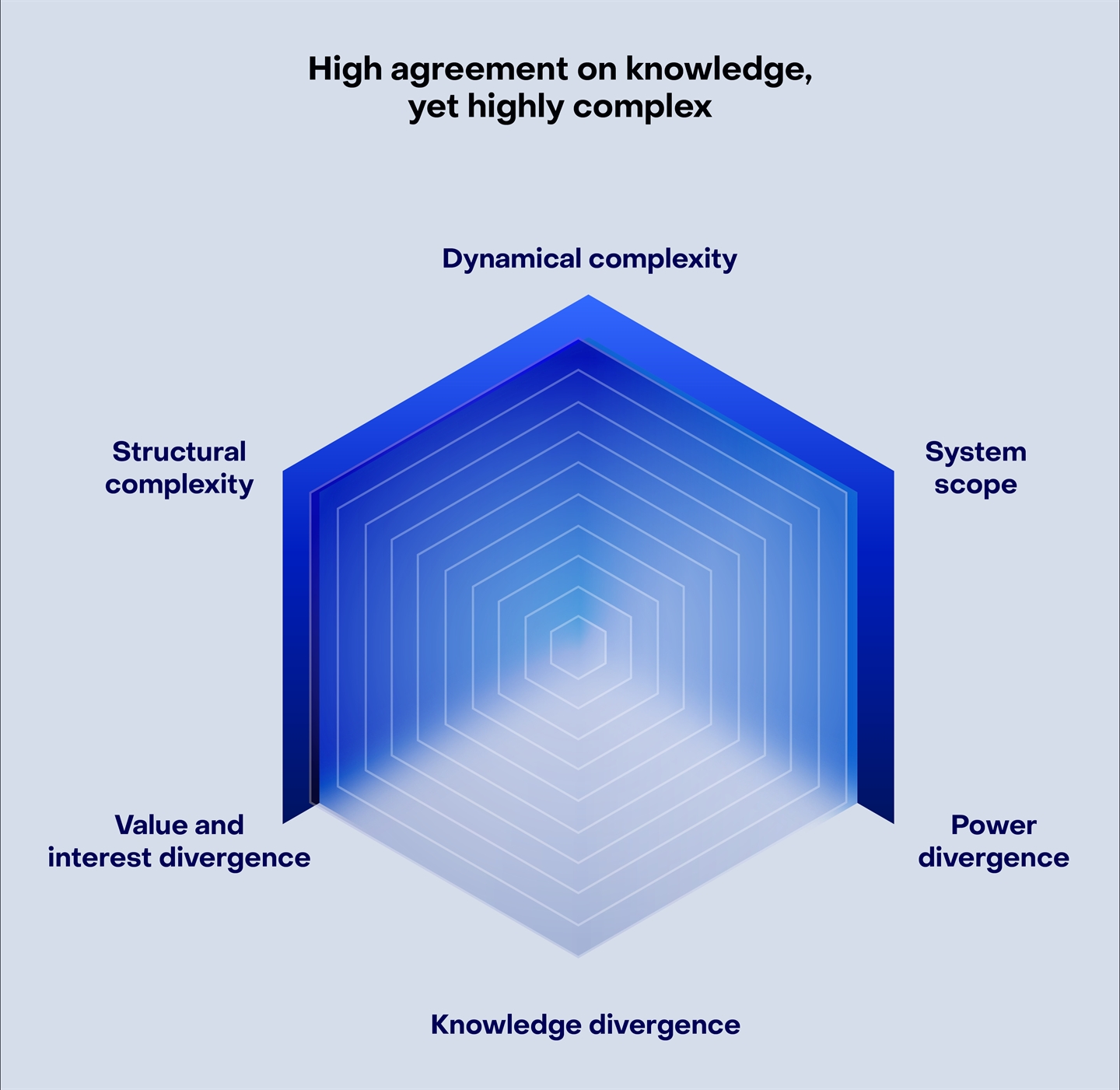
High agreement on knowledge, yet highly complex.
Three practical applications
This framework can be used in several ways:
1.
A scientifically grounded tool for problem analysis.
The complexity profile helps identify which aspects contribute most to a problem’s complexity and what drives discussion between stakeholders.
2.
A way to compare stakeholder perspectives and track changes over time.
It can show how the nature of a problem changes, for example when normative conflict grows, so that action can be taken in time.
3.
A guide for choosing appropriate interventions.
The framework helps select methods and interventions. High dynamic complexity may call for modelling and experimentation, while strong divergence in values and interests may call for participatory methods.
From complexity to a course of action
Many societal transitions stall when complex issues are approached from only one limited perspective. By first creating a complexity profile, it becomes clear whether the main attention should go to system dynamics, knowledge uncertainty, value conflicts or the distribution of power. This supports more targeted choices between approaches such as systems analysis, scenarios, modelling, participation or governance design. Within TNO Vector, we work every day on societal transitions and complex policy challenges. A better understanding of complexity gives a clearer view of possible interventions, governance models and forms of collaboration.
Would you like to know more?
Are you dealing with a complex policy or transition challenge and looking for direction on decision-making or interventions? Discover how systems analysis and systems innovation can help move from understanding the problem to targeted interventions.
Meet the authors



Questions? Get in touch with me
-

Claudio Lazo
Functie:Digital policy and innovation scientistSpecialisatie niet bekendI am Claudio Lazo, digital policy and innovation scientist at TNO Vector. As an interdisciplinary ICT policy scientist, I focus on the impact of digital technology on society – in particular artificial intelligence (AI).
-
E-mail:E-mail Claudio
-
LinkedIn:Claudio on LinkedIn
-