A broader perspective on earning capacity and space for a future-proof Netherlands
The Netherlands is facing a range of interconnected societal challenges, such as the energy transition, housing construction, nature restoration and geopolitical uncertainty. This challenges are placing significant pressure on both our economy and our limited land resources. With a new framework, TNO Vector offers this broader perspective. It helps policymakers and planners assess earning capacity, use of space and societal value in an integrated way.
A broader perspective on earning capacity and space
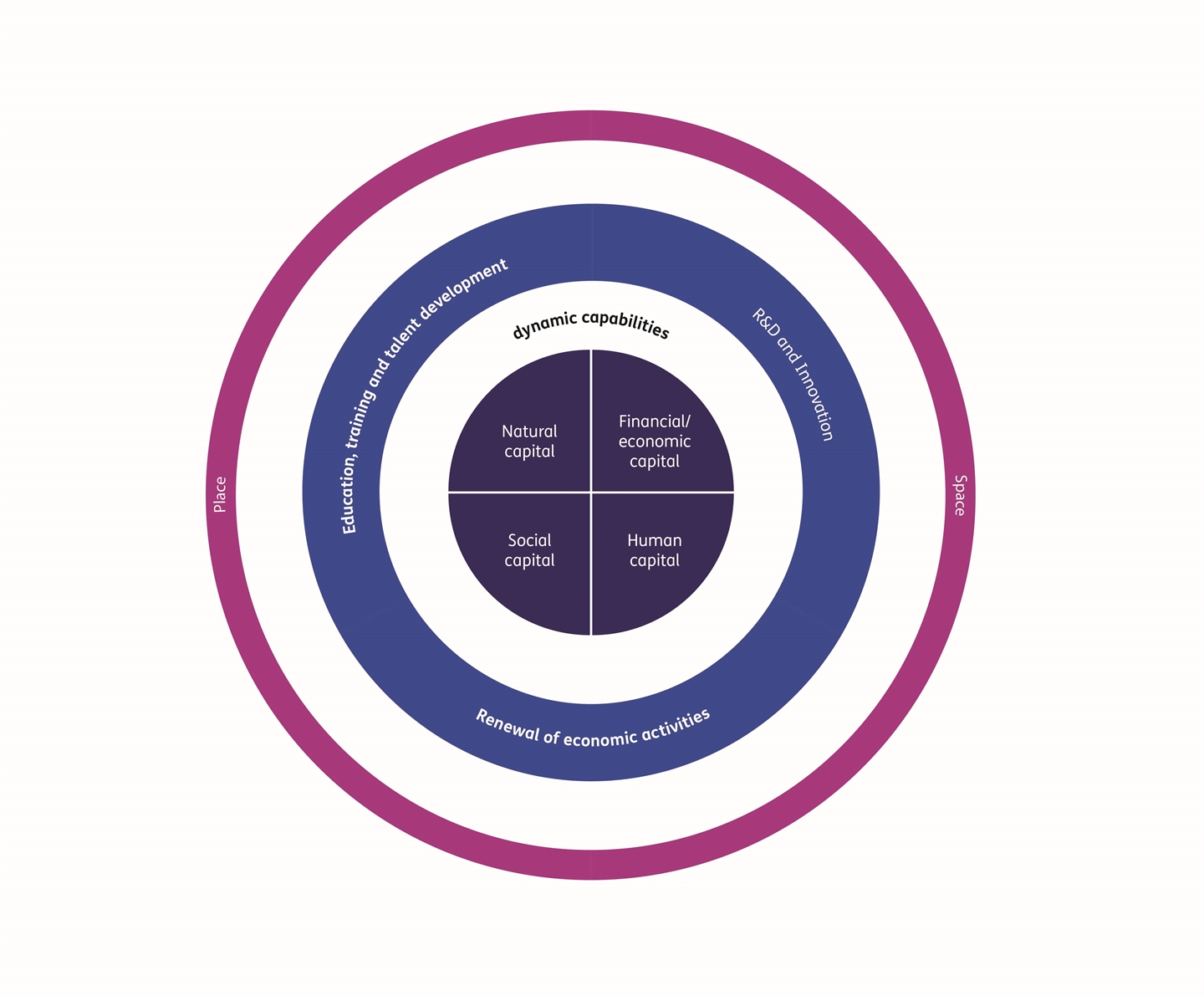
In the framework, we argue for broadening the concept of earning capacity. It’s not only financial and economic capital that matters, but also human, social and natural capital.
From these forms of capital, we look at the adaptive capabilities of companies and institutions and their ability to respond to societal and economic change. This adaptive capability takes shape through activities such as research and innovation; renewal of economic activities; and education, training and talent development.
As all these activities manifest themselves spatially, a broader perspective on use of space is also needed. We distinguish between:
- Space: physical space, such as locations, infrastructure and networks
- Place: the social, cultural and institutional embedding of places
Only when space and place come together does room emerge for productive, innovative and resilient development. The four capitals, adaptive capability, three activities and a broad perspective on use of space together determine how agile and future-proof our economy is.
The TNO Vector Framework
The TNO Vector framework
The TNO Vector Framework translates this broader perspective on earning power and use of space into a practical matrix with strategic questions. For each form of capital and each activity, the framework provides insight into:
- the physical space required (space)
- the social, cultural and institutional conditions that determine success (place)
The framework helps users assess spatial and economic choices not in isolation, but in relation to one another.
Using the framework in practice
In developing the framework, explicit attention was paid to how governments can apply it. This results in the following guiding principles:
- Deploy the framework from the start. Use the matrix already in the policy development phase as a discussion and assessment tool to reveal synergies, tensions and preconditions.
- Look at outcomes in an integrated way. Strategic questions from the matrix only gain meaning when considered in relation to one another and when they reinforce or constrain each other.
- Approach space and place as complementary. Physical space enables activities, but social and institutional conditions determine whether locations actually lead to innovation and value creation.
- Make dependencies explicit. The framework forces spatial choices to be assessed in terms of their effects on knowledge development, the labour market and adaptive capability.
- Support adaptive capability in a targeted way. By explicitly facilitating the three activities of the framework spatially and institutionally, room is created for adaptation and renewal.
- Work towards a future-proof earning capacity. By structurally taking economic/financial, human, social and natural capital into account, spatial strategies become more robust and sustainable.
Actionable perspectives
The strategic challenge for the Netherlands lies in connecting the allocative power of space with the organising power of place. Only by handling these perspectives in an integrated way can spatial-economic strategies better respond to the major transitions of our time. The TNO Vector Framework offers a concrete and actionable perspective for a resilient, inclusive and future-proof earning capacity.
Meet the authors


Questions? Get in touch with us
-
David Dooghe
Functie:Senior researcher and advisor space, technology and transitionSpecialisatie niet bekendI am David Dooghe, senior researcher and consultant around space, technology and transitions at TNO Vector. Trained as an architect and urban planner, I focus on the spatial (policy) challenges and incorporation of technologies, and broader transitions, such as the health, energy or mobility transition.
-
E-mail:E-mail David
-
LinkedIn:David on LinkedIn
-
-
Chris van der Valk
Functie:Strategic Partnership DeveloperSpecialisatie niet bekendAt TNO Vector, I develop new partnerships and build further upon existing ones for a more sustainable, livable and resilient society. Together with my excellent team of researchers, consultants and project managers – at TNO Vector and TNO-wide – I address societal challenges mainly from three areas of expertise: economics, governance and spatial use. To get to well-balanced integral solutions, we mostly combine these knowledge areas and even connect them to others like digitalization.
-
E-mail:E-mail Chris
-
LinkedIn:Chris on LinkedIn
-