Robotisation is essential for the Dutch manufacturing industry
The Dutch manufacturing industry is at a crossroads. Although the sector remains a crucial pillar of the Netherlands’ economic strength, the pressure is increasing rapidly. An ageing population, structural labour shortages and relatively high labour costs are straining the country’s competitiveness. At the same time, productivity growth is lagging behind. Without decisive action, the Netherlands risks losing ground to countries that are investing in robotisation more quickly and on a larger scale.
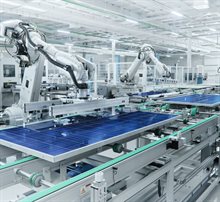
This is evident from the new TNO Vector report (in Dutch) ‘Without robotisation, the Dutch manufacturing industry will disappear: urgent action is necessary’. The message is clear: to remain internationally competitive, productivity must rise significantly over the next ten years. Robotisation is not a luxury but a prerequisite.
Industrial robot deployment remains limited
The Netherlands lags behind global frontrunners such as South Korea, China and Germany in the deployment of industrial robots. Large scale adoption is particularly lacking among SMEs. Many companies consider their production processes too complex or too variable for automation. Yet practical examples show that smart, flexible robotic solutions, such as cobots and adaptive systems, offer major opportunities, even in high mix, low volume production environments.
According to Claire Stolwijk, principal consultant and one of the report’s authors, waiting is no longer an option: ‘Robotisation is not just about technology; it is about securing the future of our industry. If the Netherlands does not invest now, the sector will face higher costs, lower productivity and ultimately a loss of competitiveness within just a few years.’
Accumulating risks
The report shows that risks are increasing in the short, medium and long term. In the short term, labour shortages lead to inefficient production and rising costs. In the medium term, this might lead to outdated production lines and missed productivity gains which widen the competitive gap. In the long term, structural decline threatens, with the possibility of factory closures and greater dependence on foreign suppliers.
Robotisation creates opportunities
At the same time, robotisation offers significant benefits: higher and more stable productivity, improved product quality, lower error margins and more attractive work for employees. Robots take over heavy, repetitive or unattractive tasks, enabling people to focus on work with higher added value.

‘Such an agenda must give companies concrete guidance, align investment decisions and reduce fragmentation. Standardisation, open source solutions and pooling of demand are essential to create the scale needed to attract system integrators and accelerate implementation.’
Claire Stolwijk, principal consultant
A national robotisation agenda
The researchers therefore call for a national robotisation agenda with clear long term objectives. ‘Such an agenda must give companies concrete guidance, align investment decisions and reduce fragmentation. Standardisation, open source solutions and pooling of demand are essential to create the scale needed to attract system integrators and accelerate implementation,’ says Stolwijk.
Investment in people is equally vital. Reskilling, robotics competencies and strong collaboration between industry and education determine whether robotisation will truly take root on the work floor.
Engine for productivity
The report’s message is urgent yet hopeful: the Netherlands has a strong ecosystem, high quality knowledge and a unique position in flexible manufacturing. With the right choices, robotisation can become a driving force for productivity, resilience and strategic autonomy.
Questions? Get in touch with me
-

Claire Stolwijk
Functie:Principal consultantSpecialisatie niet bekendI work at TNO Vector as a Principal Consultant. My focus is on digitalisation of the manufacturing industry, digital sovereignty, data spaces and industrial innovation policy. I combine scientific work with a practical approach and coordinate several national and European projects.
-
E-mail:E-mail Claire
-
LinkedIn:Claire on LinkedIn
-