
From high-tech innovation to defence capability
The war in Ukraine, increasing geopolitical competition and pressure on international supply chains have exposed the need for Europe to strengthen its defence-industrial capacity. At the same time, technological change is transforming warfare and shortening the time available to turn new knowledge into operational capability. The Netherlands has a strong knowledge and industrial base, but the challenge is to translate these strengths more rapidly into scalable production and deployable capabilities.
A significant part of this potential lies outside the traditional defence industry. Dutch high-tech companies possess technologies, knowledge and manufacturing capabilities that can be relevant to defence.
Download the whitepaper ‘Why High-tech matters for Defence transformation’
This is not only an innovation challenge: technological advantage creates military value only when systems can also be produced, replenished and adapted at sufficient scale.
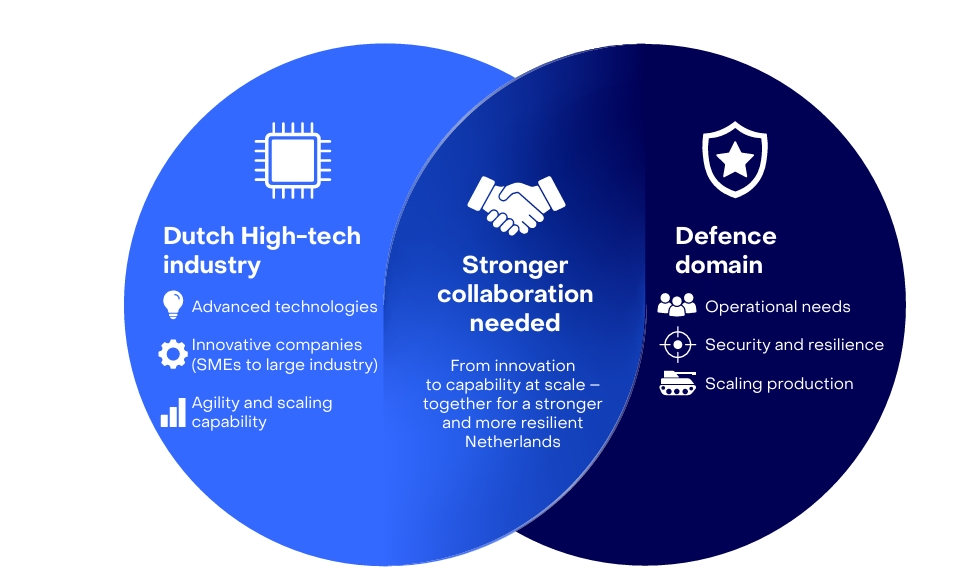
Overlapping interest and potential for capability building between Dutch HTI and the Dutch Defence domain.
Scaling while remaining adaptable
Scaling defence capacity means more than building additional production lines. Future defence-industrial capacity must be able to respond to changing operational requirements, continuously incorporate innovation and scale production when crises require it. At the same time, companies need viable business models when defence demand decreases. Long-term government commitment, dual-use markets and access to export markets can help create the conditions for companies to invest in production capacity, knowledge and supply chains.
This is where high-tech industry can make an important contribution. High-tech companies have experience with short innovation cycles, experimentation, multidisciplinary collaboration and continuous improvement based on user feedback. Defence, in turn, provides opportunities to test and further develop technologies under demanding operational conditions. This creates a potentially valuable interaction in which both domains benefit from each other's knowledge and experience.
From sensors to intelligent systems
The opportunities become tangible across several technology areas. Advanced sensors already used in sectors such as automotive and robotics can contribute to detection, monitoring, situational awareness and threat assessment. Combining sensors with AI and machine learning can further strengthen these capabilities.
At the same time, modern defence increasingly depends on integrating different technologies into coherent operational systems. High-tech expertise in complex digital ecosystems can contribute to the development of intelligent and autonomous systems, including drones, robotic systems and autonomous vehicles.

Technology centred around people offers another opportunity. Sensors, wearables and smart materials developed for fields such as sport and healthcare can potentially be adapted to support military personnel in operational environments, for example by monitoring readiness and performance.
From individual innovations to ecosystems
The opportunity, however, goes beyond individual technologies. The objective should be to create the conditions in which companies, defence organisations and research organisations can collaborate over the longer term, allowing knowledge to accumulate and innovation to emerge continuously. One approach is to develop challenge-driven ecosystems, like the National Crypto Strategy, around strategic themes rather than isolated projects. Long-term demand and government or defence organisations acting as launching customers can further give companies the confidence to invest and develop new capabilities.
This also places dual-use innovation in a broader strategic perspective. Civil technologies can be adapted for defence applications, while defence-driven innovation can also create civilian value.
Combining civilian and military markets can support larger markets for technologies and provide a more stable basis for building sustainable businesses.
Connecting the two worlds
The Netherlands can strengthen its defence capacity by mobilising the capabilities already present across its broader industrial and high-tech base. This means combining technological innovation with manufacturing capacity, systems integration and resilient supply chains, so that new capabilities can be produced, maintained and adapted at scale.
Doing so requires more than matching promising technologies with military applications. Geopolitical dependencies, security of supply, procurement and innovation policy, industrial capabilities and ecosystem development all need to be considered together. By connecting these strategic perspectives to research agendas and concrete innovation programmes, the Netherlands can strengthen its defence capacity while developing a more resilient high-tech and defence ecosystem that can deliver.
TNO Vector helps organisations navigate these challenges by bringing the right stakeholders together, creating shared objectives and translating complex ambitions into concrete, feasible actions.
Insight: Orchestrating innovation helped Defence innovate faster for a smarter and more agile armed forces
Meet the authors



Questions? Get in touch with us
-

Hanne Österberg
Job title:Innovation OrchestratorSpecialisation unknownI am an Innovation Orchestrator with a passion for harnessing technological capabilities for the benefit of society. My focus is on the defence and high‑tech sectors, where I lead collaborative innovation programmes that strengthen our autonomy and resilience. In doing so, I concentrate on accelerating progress precisely where it matters most.-
E-mail:E-mail Hanne
-