Building resilience together

Author: Ron Oren
‘Predicting the future is a mug’s game,’ Douglas Adams once said. In other words, those who try to predict the future are rarely right. Yet we cannot escape the fact that every product developed, every policy designed and every choice made has an impact on the future. Making decisions based on the present alone is just as much a mug’s game. Is this then a case of ‘damned if you do, damned if you don’t’? Not necessarily: the trick is to increase resilience – of individuals, of organisations and ultimately of society as a whole. This is done by keeping options open that are useful across multiple possible futures.
Foresight: systematically exploring multiple futures
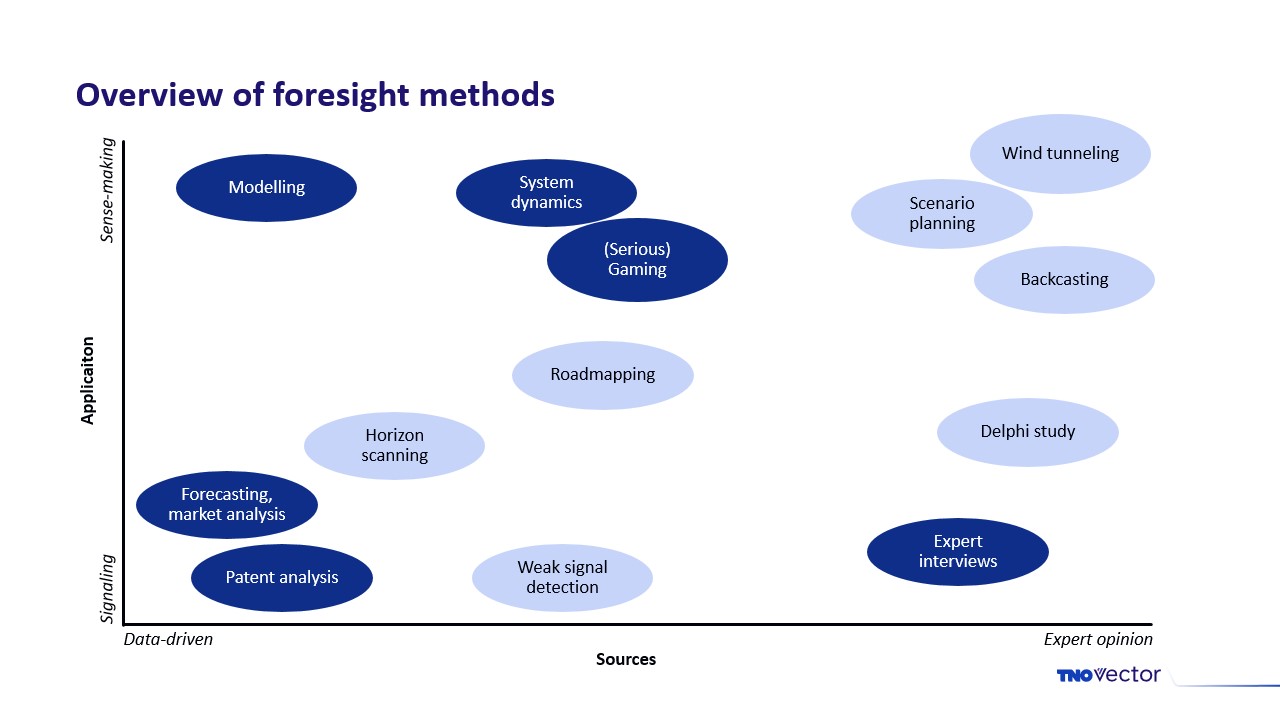
Foresight is a way to systematically explore several possible futures. There are many methods for doing so, each with its own advantages and drawbacks. Some methods (light blue in the overview) are specifically designed for foresight, but methods from other disciplines are also frequently applied in foresight (see the dark blue examples).
The choice of method depends on the situation for which the foresight is needed. Take for example a government developing a policy for its own country: by and large they determine their own future. In this case, it is useful first to define what the ideal situation would look like (visioning) and then work back from there to identify the steps required to achieve it (backcasting). A very different example is a company seeking to enter a new market. Such a company has limited influence over what will happen and is better off considering which strategy would work well across different situations (scenario analysis).
What all approaches have in common is that foresight is not intended to predict exactly what will happen, but to be better prepared for a wide range of developments.

‘By jointly developing scenarios, working with personas and using game-based approaches, the results of foresight become clearer and participants become more deeply engaged.’
Ron Oren, Innovation policy advisor
How do you engage people in the process?
The outcomes of foresight are closely linked to the design and participants of the process. There is rarely a single right answer; in fact, even with 20:20 hindsight it’s hard to say if an outcome was truly ‘correct’. Hence it is important to actively involve future users - not only for them to understand rationally what different scenarios might mean, but to truly experience and internalise them.
An effective approach is to jointly develop future scenarios. The foresight practitioner maps relevant trends, developments and unexpected twists. However, it is the users who are best placed to determine which trends are important for their situation, as they know their context better than anyone. By discussing the implications of key trends together, a scenario emerges that genuinely resonates with their lived experience. In addition, participants who help shape the scenarios themselves feel greater ownership and are more likely to act on the insights.
Another way to break participants out of their current mindset is to work with personas. These are fictional but credible profiles of people who play a role in the future landscape. By stepping into the shoes of a persona, participants can more easily adopt a different perspective on the future. Introducing personas in a playful way lowers the threshold for participation. Personas have long been used in marketing and business strategy, and the concept is also well established in foresight. What is more innovative is extending the persona concept to companies, interest groups or political parties. This adds realism to a workshop, as many issues involve not only individuals but also organisations.
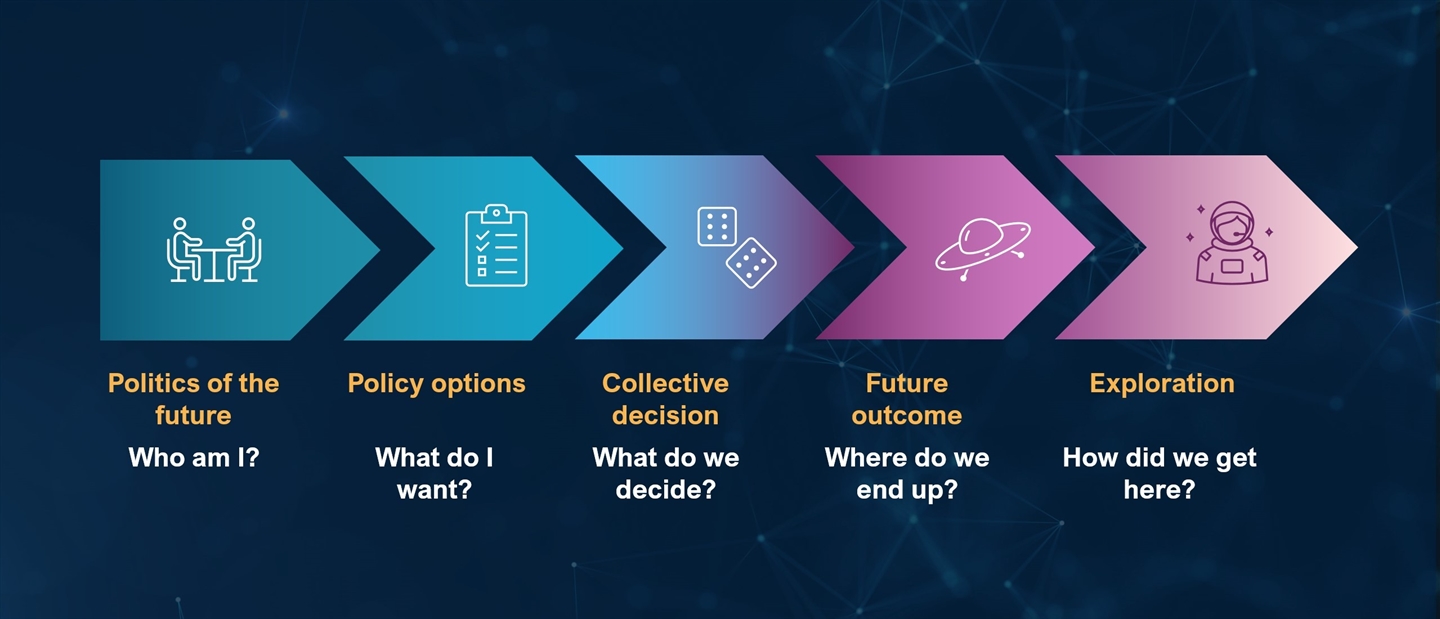
To make the future even more tangible, games can be highly effective. In a serious game, participants step into someone else’s role and explore what a possible future might mean for them in a playful setting. For example, in a project on online platforms, participants took on the role of future political parties negotiating policies, within the simple guidance framework shown below. A competitive atmosphere quickly emerged, with everyone trying to achieve the most favourable scenario for ‘their’ party. This kind of approach is not only engaging but also helps people to genuinely immerse themselves in alternative worlds and unexpected outcomes.
By jointly developing scenarios, working with personas and using game-based approaches, the results of foresight become clearer and participants become more deeply engaged. This increases the likelihood that insights from the process will be applied in practice.
What can be done with the outcomes?
A good foresight process can delivers two key outcomes. First, there is the direct result: what might the future bring? Which decisions work well across multiple futures or keep options open? What courses of action lead towards a desired future?
In addition, there is the equally valuable indirect outcome: participants learn consider problems and opportunities in a different light. This helps them develop their own (personal and organisational) resilience and makes it much easier to devise future‑proof solutions to new challenges. With every foresight process that is undertaken together, we gradually build resilience in society – like a vaccination against future uncertainty and shocks.
Next steps
The world is changing rapidly, which makes it all the more important to make the right decisions now. Decisions that are future‑proof. Decisions that keep options open without standing still. In short, decisions grounded in resilience. Foresight does not, of course, provide all the answers, but it does help to ask the right questions and thereby to make better decisions. Whether you are looking for concrete outcomes or want to learn to approach challenges differently, we are ready to work with you to choose the best method or develop an entirely new approach that fits your needs perfectly. Take the first step today and discover how foresight can help your organisation move forward.
Questions? Get in touch with the author
-

Ron Oren
Functie:Innovation policy advisorSpecialisatie niet bekendI am Ron Oren, innovation policy advisor at TNO Vector. I enjoy tackling complex problems where multiple stakeholders have conflicting views and goals; with me creating order and a common vision.
-
E-mail:E-mail Ron
-